Current Issue

Volume: 12 Issue: 2 , 12/5/25

Year: 2025

Research Article

Book Review

Meeting Abstract

Meeting Abstract

1. CİSEM2025'in Ardından

ILEF Journal is an academic, peer-reviewed publication in the field of communication research and media studies. It aims to offer a free and critical platform for researchers, reflecting diverse intellectual traditions and interdisciplinary approaches. It is published biannually online and with open access by Ankara University Faculty of Communication, which is the oldest academic institution in the field of communication.


ILEF Journal is open to studies that touch on themes of class, gender, and ethnicity in visual-auditory culture, in both traditional and new media; it welcomes research that interrogates the history and theories of journalism, film, television, video, and digital media, and that takes a critical perspective on the field of communication.

Article Submission Rules and Publishing Process  


Submitted articles are first reviewed by the editor for purpose, subject matter, content, and adherence to writing guidelines. Those found suitable in these respects have their author names anonymized and are sent to two reviewers recognized in their field for scholarly evaluation, following the opinion of the Editor and/or the Editorial Board. Under no circumstances are the reviewers given the author's name, nor are the reviewers' names disclosed to the authors.
Authors are requested to make any adjustments specified by the reviewers or requested by the editors using Microsoft Word’s “track changes” feature. Authors may notify the editorial board of their summaries, comments or objections regarding the changes requested during the evaluation process with a revision report.
Reviewer reports are kept for two years. If one reviewer report is positive and the other is negative, the article may be sent to a third reviewer, or the Editorial Board may make the final decision based on the reports. Authors take into consideration the criticisms, suggestions, and corrections requested by the reviewers and the Editorial Board.
Approval is obtained from the author for articles ready for publication.
Each author is sent a printed copy of the journal.

Author Guidelines
Articles submitted to the journal must fully comply with the following rules. Articles that do not comply with the writing rules will not be considered for review.

Articles submitted to the journal, including footnotes and bibliography, should not exceed 12,000 words.
Articles submitted to the journal should include abstracts of 230-250 words in Turkish and 280-300 words in English, along with 5 keywords, and titles in both Turkish and English. Abstracts should include the purpose, significance, method, and results of the study.
In addition to the article, authors should submit a cover file containing the author's short biography, contact and ORCID information, and a signed copyright transfer form by the author(s).
The submitted document and file properties should not contain any terms that reveal the identity of the author. The text and footnotes should not provide information about the author's name or institution, nor should they refer to theses, projects, etc., that underpin the article. Such footnotes should be included in a cover file containing author information. If the author feels the need to provide additional information about the history of the article, this should be indicated in the cover file submitted with the article.
All articles in ILEF Journal must display in-text references and bibliographies according to the Chicago Reference Format's author-date system. For this, you can refer to our Reference and Text Format page.
Titles used in the article should be short and clear.
Articles should be written in Times New Roman font, 12 point size, and double-spaced in doc or docx file format. Footnotes should be written in 9 point size and single-spaced.
The main title and subtitles of the article should be bold and the first letters of the words should be capitalized.
Quotes exceeding 40 words should be indented one centimeter from the paragraph, in block format, single-spaced, and in 11 point size.
When quoting, sources should be written under tables and figures.
For any inquiries regarding article submission and the journal, contact can be made via the email address ilefjournal@gmail.com.

ILEF Journal Ethical Principles and Publication Policy

ILEF Journal is a peer-reviewed publication in the fields of communication research and media studies. It aims to provide a free and critical platform for researchers, reflecting diverse intellectual traditions and interdisciplinary approaches. The journal is open to research that addresses visual-auditory culture, traditional and new media, themes of class, social gender, and ethnicity; as well as studies that question the history and theories of journalism, film, television, video, and digital media, and take a critical look at the field of communication.


Published biannually in print and online formats in May and November, the journal is produced by Ankara University's Communication Faculty , the oldest academic institution in the field of communication in Turkey and surrounding areas. The publication adheres to the ethical principles and publication policy detailed below, guided by the guidelines prepared by the Committee on Publication Ethics (COPE, https://publicationethics.org/). ILEF Journal does not charge any fees for article submission or publication process.


Evaluation and Publication Process

The evaluation and publication processes of articles submitted to ILEF Journal are continuous. Therefore, except for themed special issues, no final submission deadlines are set for each issue. Articles deemed suitable after a preliminary review are taken through the peer review process and published in the issue of the current period (May or November). Due to the Editorial Board's decision to limit each issue to 5-7 articles, submissions that exceed this limit based on their acceptance date are held over for publication in the next period’s issue. ILEF Journal accepts submissions via DergiPark.


Correction and Withdrawal Processes

The editor or reviewer(s) may request corrections and changes on the articles submitted to the ILEF Journal. Authors are expected to comply with these requests if they find them reasonable and if not, they must explain why they cannot fulfill these requests. Authors have the right to withdraw their submissions at any stage of the publication process.


Publisher's Responsibilities

ILEF Journal is published by the Communication Faculty of Ankara University (ILEF). The dean of the faculty serves as the proprietor and chief editor on behalf of ILEF. The journal's editorial board is composed of members recommended biennially by the departments within ILEF. The relationship between ILEF Journal's editors and Ankara University is founded on absolute editorial independence.

Ankara University’s Faculty of Communication promotes and distributes ILEF Journal; it protects the printed editions, and the intellectual property rights of the authors and publishing partners. Readers may share ILEF Journal materials provided they cite appropriately; they can copy, redistribute in any medium or format, and modify the materials. However, ILEF Journal materials cannot be used for commercial purposes nor subjected to legal or technological restrictions that limit others' rights beyond the scope of the license.

The original submissions by authors, any modified and edited versions during the evaluation process, and the published text can be archived by the authors in the medium of their choice.


Editorial Responsibility

Editors are obligated to oversee the review and publication process of each submission within the framework of ILEF Journal's Ethical Principles and Publication Policy. They are responsible for every text they publish, and the sole responsibility for accepting or rejecting an article lies with them. Editors may consult reviewers or editorial board members when making decisions related to the publication process. Articles are considered and accepted based on their academic merits.

Editors are committed to continually improving ILEF Journal and enhancing its publication quality. They ensure the necessary critical discourse environment is provided in the field of communication. Editors and the editorial staff must not disclose any information about a submitted article outside of the appropriate channels, which include discussions with the relevant author, reviewers, potential reviewers, other editorial advisors, and the publisher.

Each article must be treated impartially; evaluations must be made without consideration of the author's gender, political views, seniority, or institutional affiliations. Editors are also responsible for taking necessary actions against intellectual property infringements, unethical scientific practices, and instances of plagiarism.

The relationship between editors and the publisher is based on the principle of independence. Decisions made by editors are independent from the publisher and any other entities. Editors prioritize public interest over personal gain in their publishing activities.

Articles submitted by authors who have a conflict of interest with editors are reviewed by a member of the Editorial Board. To ensure a fair and impartial process, submissions by Editorial Board members are reviewed by an assistant or guest editor.

At least one reviewer for each article must have no affiliation with ILEF. Members of ILEF should not review submissions from their colleagues within the faculty.


Author Responsibilities

Authors submitting texts/work to ILEF Journal must ensure that their submissions are original and free of plagiarism. Authors must cite sources used in their work ethically and in accordance with the journal's format.They should ensure that the submitted work has not been previously published elsewhere and is not under consideration by multiple outlets simultaneously. Authors should avoid using sexist or discriminatory language and must disclose any potential or apparent conflicts of interest, including funding and grants.

Submissions must not violate the privacy and intellectual property rights of third parties. Authors are responsible for securing the necessary usage rights and permissions related to the data used in their research and for documenting these permissions if requested. Ethical approval must be obtained in the following cases:
- Research involving data collection from participants using methods such as surveys, interviews, focus groups, observations, experiments, or interviewing techniques,
- Use of humans and animals (including materials/data) for experimental or other scientific purposes,
- Clinical research on humans,
- Research on animals,
- Retrospective studies as required by personal data protection laws.
Additionally:
- It should be stated that informed consent forms have been obtained in case reports,
- Permission should be obtained and stated for the use of scales, questionnaires, photographs owned by others,
- Compliance with copyright regulations must be adhered to for the use of intellectual and artistic works.
No ethical committee approval is required for review articles. Retrospective ethical committee approval is not required for articles that utilize data prior to 2020, are derived from master's/Ph.D. research (which should be mentioned in the article), were submitted to the journal the previous year, accepted but not yet published.

Authors who are not affiliated with a university may also apply to ethics committees in their regions. Articles to be published in journals should indicate whether ethical committee or special/legal permission is needed. If such permissions are necessary, the committee's decision should be noted in the article in footnote format with the committee's name, date, and number. Furthermore, the document demonstrating the ethical committee's decision should be submitted to ILEF Journal along with the article.

During the review process, authors may be requested to provide raw data related to their studies, and they should be prepared to present these data when submitting their work to ILEF Journal. If the study is published, authors are obligated to retain the related data for five years.

Authors must disclose all individuals who contributed to the work; significant contributors should be listed as co-authors, and consent must be obtained from all co-authors before submission. The Copyright Transfer Form must be completed by the responsible author and submitted with the work.

Articles based on one or more sections of a master's or doctoral thesis are expected to be single-authored. If a version of the work/text has been previously published elsewhere, this must be disclosed. 

All samples, quotations, tables, and images that exceed the "fair use principle" defined by current copyright law must have permissions obtained by the authors. Changes in authorship (removal, addition, or rearrangement of authors) of submissions under review cannot be proposed. If a conflict of interest, ethical violation, or error is detected during the review process, authors must share the issue with the editor and demonstrate the necessary diligence for correction or withdrawal.

Attention to author diversity means that the same authors should not publish in ILEF Journal at short intervals. As a principle, for an article accepted after the review process to be published, the authors must not have published in the previous six issues (three years) of ILEF Journal.


Reviewer Responsibilities

ILEF Journal employs a double-blind peer review system in which the identities of reviewers and authors are kept confidential from each other throughout the evaluation process. Reviewers are expected to adhere to the following principles during their review of submissions:
- Reviewers should assess the work fairly and impartially.
- Reviewers must maintain the confidentiality required by the blind peer review process.
- Reviewers should inform the journal editor of any actual or potential instances of plagiarism, duplicate publication, or simultaneous submission they might discover.
- Reviewers should decline to review any article where there is a conflict of interest or any form of potential bias.
- Reviewers should only agree to review works that are within their area of expertise.
- Reviewers should provide constructive feedback and avoid derogatory or harmful comments.
- Reviewers should make every effort to complete their reviews within the specified deadlines.
- Reviews should be conducted considering the ethical principles and publication policies of ILEF Journal.
If reviewers are unable to evaluate a work for any reason, the journal editor will be open to suggestions for alternative reviewers who can assess the article.


Plagiarism and Unethical Behavior

Before any manuscript is accepted into the review process, ILEF Journal subjects it to a plagiarism check using a plagiarism detection software. The results are reviewed by the editor, who then decides whether the manuscript will be accepted into the review process. Additionally, based on the outcome of the similarity check, the editor may request revisions from the authors if deemed necessary.

Readers, researchers, reviewers and authors should inform ilefjournal@gmail.com in case of any violation of the above-mentioned İLEF Journal Ethical Principles and Publication Policy and academic ethical principles in an article that is under evaluation or published.
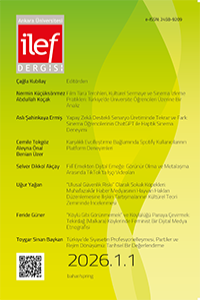

İLEF Dergisi makale gönderim ya da süreç işletimi için herhangi bir ücret talep etmemektedir

Editör

Çağla Kubilay
Prof. Dr. Çağla KUBİLAY ANKARA ÜNİVERSİTESİ
Media Studies, Journalism, Journalism Studies, Communication Studies, Communication Theories, Communication Sociology, Women's Studies

Yayın Kurulu

Semire Ruken Öztürk
Prof. Dr. Semire Ruken ÖZTÜRK ANKARA ÜNİVERSİTESİ

Lisans ve lisansüstü eğitimini Ankara Üniversitesi’nde tamamladı. 1992-98 arası Ankara Üniversitesi Eğitim Bilimleri Fakültesi’nde araştırma görevlisi olarak çalıştı, 1998'de doktorasını tamamladı. 1999’dan bu yana Ankara Üniversitesi İletişim Fakültesi’nde çalışıyor; 2001 yılından bu yana da ODTÜ’de Film Analysis dersini vermektedir. 2004’de doçent, 2010’da profesör oldu. çeşitli dönemlerde Bölüm Başkanlığı, Senatörlük (2010-2012) ve Dekanlık (20 Eylül 2012-15 Kasım 2015) yaptı. Üç dönem İLDEK (İletişim Fakülteleri Dekanları) Yürütme Kurulu Başkanlığı yaptı. Sinema Anabilim Dalı Başkanı olan Öztürk, halen İletişim Fakültesi Radyo Televizyon ve Sinema Bölüm Başkanı'dır. Sinema alanında çeşitli kitap ve makaleleri bulunmaktadır. Türkiye’nin ilk hakemli sinema dergisi sinecine: Sinema Araştırmaları Dergisi’nin kurucularındandır ve editörlüğünü yapmıştır, halen derginin yayın kurulundadır. 2014 yılında dekanlığı döneminde yayımlanmaya başlayan İlef Dergisi'nin Yayın Kurulu'ndadır, çeşitli sayılarda editörlük de yapmıştır.

Cinema Studies, Movie Review, Cinema Theories
Communication and Media Studies, Media Studies, Journalism Studies, Turkish Political Life, Late Modern Press History, Communication History, Ottoman history
Özgür Yaren
Prof. Dr. Özgür YAREN Chulalongkorn University
Cinema Theories, Cinema and Aesthetics
Public Relations Campaigns and Applications, Public Relations Methods and Instruments
Ali Karadoğan
Prof. Dr. Ali KARADOĞAN MUNZUR ÜNİVERSİTESİ, İLETİŞİM FAKÜLTESİ, RADYO TELEVİZYON VE SİNEMA BÖLÜMÜ

...

Cinema Studies, Movie Review, Cinema Theories, Cinema and Aesthetics, Cinema Studies (Other), Cinema History
Bedriye Poyraz
Prof. Dr. Bedriye POYRAZ Ankara Üniversitesi
Media Studies, Women's Studies
Burak Doğu
Prof. Dr. Burak DOĞU İZMİR EKONOMİ ÜNİVERSİTESİ
Communication Technology and Digital Media Studies
Literary Theory, Modern Turkish Literature in Turkiye Field, Contemporary Art

Editör Yardımcıları

Esra Özgür
Res. Assist. Esra ÖZGÜR Ankara Üniversitesi
Communication Technology and Digital Media Studies
Sezer Fener
Res. Assist. Sezer FENER ANKARA ÜNİVERSİTESİ
Journalism Studies, Communication and Media Studies (Other)
Communication and Media Studies, Journalism, Communication History

Danışma Kurulu

Political Science, Sociology of Culture
Default avatar
Prof. Dr. Ayla OKAY İSTANBUL ÜNİVERSİTESİ
Public Relations
Hasan Akbulut
Prof. Dr. Hasan AKBULUT İSTANBUL ÜNİVERSİTESİ, İLETİŞİM FAKÜLTESİ, RADYO, SİNEMA VE TELEVİZYON BÖLÜMÜ
Sinema, seyirci araştırmaları, görsel kültür, drama ve sözlü tarih
Mass Media
Default avatar
Prof. Dr. Martin W. BAUER London School of Economics
Social and Personality Psychology
Müjde Ker Dincer
Prof. Dr. Müjde KER DİNCER EGE ÜNİVERSİTESİ, İLETİŞİM FAKÜLTESİ
Public Relations
Erol Nezih Orhon
Prof. Dr. Erol Nezih ORHON ANADOLU UNIVERSITY
Cinema Studies
Default avatar
Prof. Dr. Nikica GİLİC University of Zagreb
Movie Review
Public Relations
Default avatar
Assoc. Prof. Dr. Sanna INTHORN University of East Anglia
Women's Studies
Default avatar
Prof. Dr. Scott SCHAFFER University of Ontario
Political Science
Public Relations

Danışma Kurulu

Inter-Organisational, Extra-Organisational and Global Information Systems, Communication and Media Studies
Erkan Saka
Prof. Dr. Erkan SAKA İSTANBUL BİLGİ ÜNİVERSİTESİ

 Erkan Saka, İstanbul Bilgi Üniversitesi Medya Bölümü'nde medya ve gazetecilik çalışmaları profesörüdür.  A Journey through Citizen Journalism, Political Trolling, and Fake News (Lexington Books, 2019) ve "Big Data and gender-biased algorithms" In The International Encyclopedia of Gender, Media, and Communication eserlerinin yazarıdır. 

Communication and Media Studies, Communication Technology and Digital Media Studies, Cultural Anthropology
Default avatar
Prof. Dr. Ayla OKAY İSTANBUL ÜNİVERSİTESİ
Public Relations, Institutional Communication
Emine Uçar İlbuğa
Prof. Dr. Emine Uçar İLBUĞA Akdeniz Üniversitesi, İletişim Fakültesi
Cinema Sociology, Movie Review, Cinema Theories, Cinema Studies (Other)
Gaye Aslı Sancar Demren
Assoc. Prof. Dr. Gaye Aslı SANCAR DEMREN Galatasaray Üniversitesi İletişim Fakültesi

Doç. Dr. Gaye Aslı SANCAR DEMREN Galatasaray Üniversitesi İletişim Fakültesi Halkla İlişkiler Anabilim Dalı Başkanı olarak görev yapmaktadır. 2012 yılında Marmara Üniversitesi Sosyal Bilimler Enstitüsü'nde “Uluslararası Halkla İlişkiler Yöntemi Olarak Kamu Diplomasisi: Türkiye İçin Bir Model Önerisi” başlıklı tezi ile Doktor ünvanını almış ve Türkiye’de iletişim bilimleri alanında kamu diplomasisi konulu ilk doktora tezini savunmuştur.

Sancar Demren’in “Kamu Diplomasisi ve Uluslararası Halkla İlişkiler”, “Kamu Diplomasisinde Yeni Yaklaşımlar ve Örnekler”, “Kurumsal İletişim Bağlamında Kurumsal Sürdürülebilirlik İletişimi” ve “Kurumların Yeni İletişim Biçimleri” ve "Dünyadan Örneklerle Kamu Diplomasisi"  isimli kitapları ve de kamu diplomasisi, halkla ilişkiler, kurumsal iletişim, kurumsal sürdürülebilirlik iletişimi alanlarında çalışmaları bulunmaktadır. 


Halkla İlişkiler, Kurumsal İletişim, Kamu Diplomasisi, Kurumsal Sürdürülebilirlik alanlarında çalışmakta ve eserler vermektedir.

Public Relations, Public Relations Campaigns and Applications, Public Relations Methods and Instruments, Institutional Communication, Corporate Social Responsibility
Default avatar
Prof. Dr. Aykut ÇELEBİ ANKARA ÜNİVERSİTESİ, SİYASAL BİLGİLER FAKÜLTESİ, SİYASET BİLİMİ VE KAMU YÖNETİMİ BÖLÜMÜ
Information Systems Philosophy, Research Methods and Theory, Constitutional and Political Theories, European and Region Studies, Political Theory and Political Philosophy, Political Sociology
Sırrı Emrah Üçer
Assoc. Prof. Dr. Sırrı Emrah ÜÇER YILDIZ TEKNİK ÜNİVERSİTESİ

1981 İstanbul doğumlu olan Sırrı Emrah Üçer Vefa Lisesi'nden 1999'da mezun oldu. İstanbul Üniversitesi İktisat Fakültesi İktisat Bölümü, Lisans Programı'ndan 2003'te, İstanbul Üniversitesi Siyasal Bilgiler Fakültesi Uluslararası İlişkiler Bölümü, Yüksek Lisans Programı'ndan 2008'de mezun oldu. Boğaziçi Üniversitesi Atatürk Enstitüsü Yakın Dönem Türkiye Tarihi Doktora Programı'nı 2018'de tamamladı. Yıldız Teknik Üniversitesi İktisadi ve İdari Bilimler Fakültesi İktisat Bölümü'nde 2009'dan beri çalışıyor. Başlıca araştırma alanları iktisat ve tarihtir. Üçer 2023 Temmuz'da YÖK ÜAK'tan İktisadi Düşünce alanında doçentlik unvanı almıştır. YÖK Akademik Profili için bakınız: http://bit.ly/3cTIvP8

Political Economy Theory, Heterodox Economics, History of Turkiye Economy
Default avatar
Assoc. Prof. Dr. Defne KARAOSMANOĞLU KADIR HAS UNIVERSITY, FACULTY OF COMMUNICATION

Doç. Dr. Defne Karaosmanoğlu, Kadir Has Üniversitesi, İstanbul, Türkiye, defne.karaosmanoglu@khas.edu.tr

Culture, Representation and Identity, Sociology of Food
Hasan Akbulut
Prof. Dr. Hasan AKBULUT İSTANBUL ÜNİVERSİTESİ, İLETİŞİM FAKÜLTESİ, RADYO, SİNEMA VE TELEVİZYON BÖLÜMÜ
Sinema, seyirci araştırmaları, görsel kültür, drama ve sözlü tarih
Cinema Sociology, Movie Review, Cinema Theories
Default avatar
Assoc. Prof. Dr. Fulya ÖZKAN AKDENİZ ÜNİVERSİTESİ
Middle East Studies, Turkish Foreign Policy, International Relations Theories, Political History
Erol Nezih Orhon
Prof. Dr. Erol Nezih ORHON ANADOLU UNIVERSITY
Communication and Media Studies, Communication Studies, Cultural Studies (Other)
Default avatar
Assoc. Prof. Dr. Emel ÖZDORA AKŞAK BİLKENT ÜNİVERSİTESİ

Emel Özdora, Bilkent Üniversitesi’nin İletişim ve Tasarım bölümünde doçent olarak görev yapmaktadır. 2009 yılında Florida Üniversitesi’nde Kitlesel İletişim konusunda doktorasını tamamlamıştır. UNICEF Türkiye Ülke Ofisi’nde iletişim uzmanı olarak çalıştıktan sonra akademik kariyerine geri dönmüştür. 2012 yılından beri Bilkent Üniversitesi’nde çalışan Doç. Dr. Emel Özdora, Reklamcılığa Giriş, Halkla İlişkiler ve İletişim Kampanyaları, Uluslararası Halkla İlişkiler ve İletişim Çalışmalarına Giriş gibi uygulamalı iletişim dersleri vermektedir. Araştırma alanlarının arasında kurumsal iletişim, itibar yönetimi, halkla ilişkiler, sivil toplum ve sosyal savunuculuk bulunmaktadır. Özdora, 2022 yılında Türkiye Bilim Akademisi tarafından Yılın Genç Bilim İnsanı Ödülü’ne layık görülmüştür. Arthur Page Center for Integrity in Public Communication’dan, Türkiye’deki göçmen ve hassas topluluklar hakkındaki araştırması için iki tane araştırma bursu kazanmıştır. Özdora’nın makaleleri; International Journal of Communication, Discourse and Communication, Public Relations Review ve American Behavioral Scientist gibi uluslararası akademik dergilerde yayınlanmıştır. 

Media Studies, Communication Studies, Mass Media